


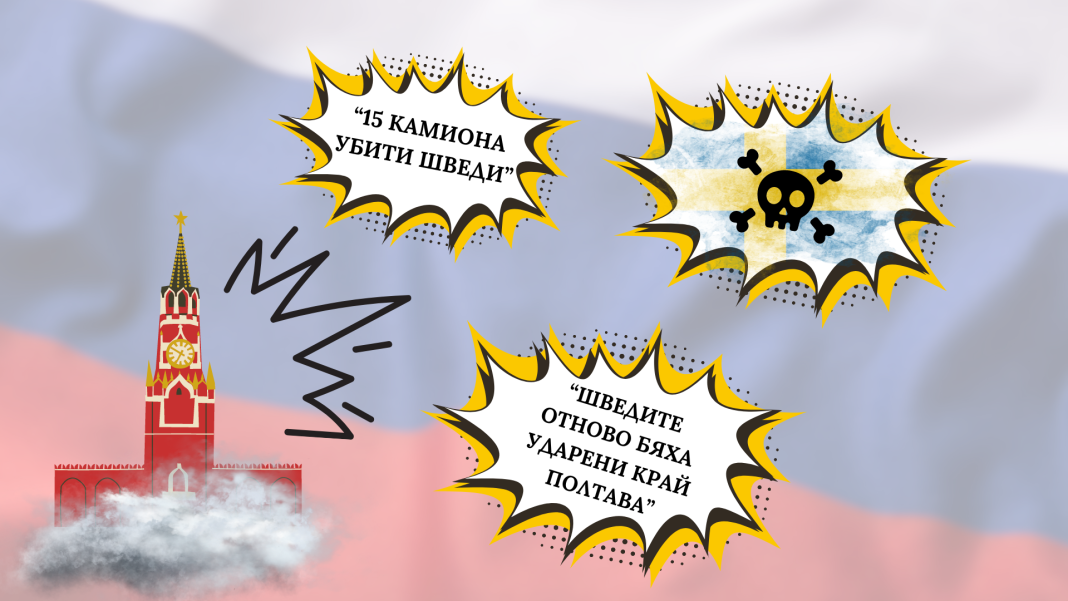
Posts circulating on social media in September claimed that Swedish citizens had died in the Russian missile attack against the Ukrainian city of Poltava. According to some of those posts, the victims were Swedish ‘military instructors’. Others speak of ’15 trucks’ of dead bodies shipped home to Sweden or claim that high-ranking staff from the Swedish military corporation SAAB perished in the attack.
Publications containing these claims were initially shared on Facebook groups with an audience of over 50 000 users. The claims were also circulated by a number of individual profiles from which they were picked up by websites such as Svobodno slovo, Plofdiv Info, Pogled.eu and Classa.bg. Those websites presented the claims as news, which were in turn reshared on social media.


The claims that Swedish people were killed in Poltava appeared in at least 4 articles on Pogled Info – a website that mostly publishes translations from Russian sources and is known as one of the main channels for pro-Kremlin disinformation in Bulgarian.


What happened in Poltava on 3 September
In the early hours of the day Russia fired missiles against the Ukrainian city. Two ballistic missiles hit a military communications institute. The attack is considered one of the deadliest since the beginning of 2024. According to Ukrainian authorities 55 people were killed and 328 were injured.
In the days following the attack Russian media started spreading claims of a much higher number of casualties. In the beginning there were reports of over 200 deaths, then 500 and soon the numbers went up to over 1000. In most cases those publications cited local witnesses or pro-Russian military blogs. The Russian state news agency TASS quoted a Ukrainian politician known for spreading Russian propaganda narratives on a number of occasions, while RIA Novosti quoted information from the Russian-appointed governor of the occupied Kherson region as their only source.


Infamous Russian propaganda outlets such as the Strategic Culture Foundation published claims that the targeted military institute had been full of ‘foreign instructors’ and ‘mercenaries’ from Western countries.
Some Russian media based their claims on a post by Britta Ellwanger, a Swedish citizen living in Ukraine and working for the US charity organisation For Peace. Outlets such as the sanctioned RT and Argumenty i Fakti published a screenshot of a social media post by Ellwanger, in which she appears to say she lost a close friend and former Swedish classmate in the Poltava attack. The claims that a foreign representative of a humanitarian organisation ‘confirmed’ the death of Swedes in Poltava were also published on Telegram by pro-Kremlin propagandist and TV host Vladimir Solovyev, whose channel has over 1.3 million followers. The same claims were circulated in Swedish by the Russian propaganda website Pravda.se. They also reached the Bulgarian information space, again with the help of Pogled Info.


The „evidence“ that Swedes were killed was fabricated
In her profiles on Facebook and Х Britta Ellwanger announced that she did not publish the post in the screenshot circulated by Russian media. She said that her identity had been used “in a Russian disinformation campaign.” Speaking to Swedish public broadcaster Svt, she said she did not know any Swedes in Ukraine, did not work with Swedish people and had never heard of anyone Swedish who had been hurt in the Poltava attack.
In a comment to the public television channel, the Swedish foreign ministry said they did not have any information about Swedish citizens killed or injured in the attack.
Sweden’s army and SAAB deny claims their staff were killed
Most of the posts by Bulgarian Facebook users on the issue speak of killed ‘Swedish military instructors’, as well as the loss of ‘the entire leadership of the SAAB airborne early warning and control systems’ – a phrase that sounds somewhat opaque in Bulgarian and most of it turns out to be a clumsy word-for-word translation from Russian sources.
On 4 September the Swedish army headquarters published a statement on their website denying the claims that members of their staff had been killed in Poltava. The army press centre described the claims as a ‘typical example of disinformation.’
Factcheck.bg reached out to the SAAB corporation, whose spokesperson also denied the rumours. “The claims that employees from SAAB have been killed in a Russian attack in Poltava are false. This is seemingly part of a disinformation campaign and there is no truth to these claims,” wrote Mattias Rådström, head of media relations for the company.
Propaganda attack against ‘the minister who brought Sweden into NATO’
On 4 September, the day following the Poltava attack, Sweden’s foreign minister Tobias Billström announced he would resign at the start of the new parliamentary season. He did not give a reason for his decision, but according to Swedish media it may be due to longstanding differences between himself and prime minister Ulf Kristersson.
The Kremlin propaganda machine took advantage of this somewhat unexpected announcement, stitching it together with the false claims that Swedish military personnel had been killed in Poltava. Billström’s resignation thus came to be presented as ‘indirect proof’ that Swedish ‘military instructors’ had indeed been annihilated in the missile attack. In its news piece about the minister’s departure, the sanctioned Russian network Russia Today specifically pointed out that Billström was the person who brought Sweden into NATO.


„Poltava all over again“
For years Sweden has been a target of Kremlin disinformation, seeking to tarnish the country’s positive international image and deepen existing divisions within Swedish society. These attacks became particularly vicious after Sweden announced it would seek NATO membership, putting an end to a 500-year tradition of non-alignment.
Following the country’s NATO accession in March, Tobias Billström’s resignation has now added a ‘cherry on top’ of the disinformation story about the killing of ‘Western military instructors’ in Ukraine. It is being used to feed Russia’s domestically and internationally promoted narrative that Sweden has reasons to regret its decision to join the Alliance, as well as its help for Ukraine as a whole.
The campaign carries an additional patriotic charge for its domestic audience, by evoking their pride of the Russian victory in the battle of Poltava in 1709. In the same area over 300 ago Russian troops led by Peter I defeated the Swedes, killing or capturing almost their entire army.
“What an irony of fate, Swedes have yet again been defeated in Poltava,” the Kremlin-controlled online edition Pravda wrote. The website quoted Russian social media users, pointing out that the soldiers who fired the missiles against Poltava were educated at a military academy named after Peter I.
Comments about ‘the second Poltava’ also found their way into publications by Bulgarian profiles circulating the false claims about Swedish casualties in the September 3 attack.


